
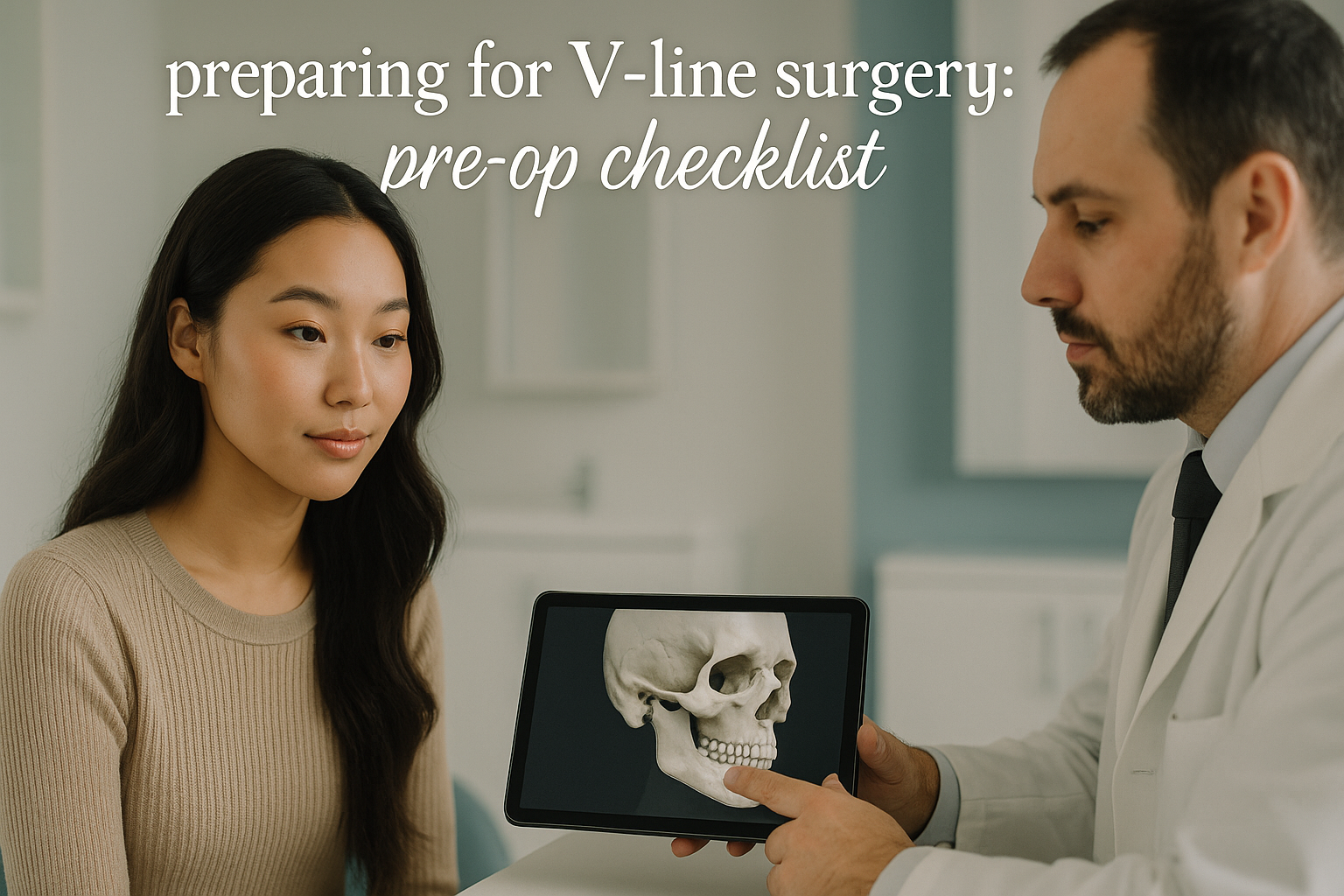
If you’re planning lower-face contouring, preparing for V-line surgery: pre-op checklist thinking is the smartest move you can make. A strong, stepwise plan lowers anxiety, reduces complications, and makes your surgical day feel calm and predictable. This guide is written for both first-time patients and clinicians who want a crisp framework; it translates complex perioperative requirements into simple, actionable steps—while staying thoroughly evidence-minded.
آنچه در این مقاله میخوانید
Why a checklist matters

In facial bone contouring, tiny oversights can ripple into big issues. Using a structured preparing for V-line surgery: pre-op checklist aligns your expectations, your surgeon’s plan, and the nursing team’s protocol. It also ensures the logistics of travel, lodging, medication timing, lab work, and informed consent are handled early—so you focus on recovery, not paperwork.
At-a-glance timeline
T-8 to T-6 weeks: surgical candidacy review, imaging, baseline labs, and dental clearance start here—your high-level preparing for V-line surgery: pre-op checklist stage.
T-6 to T-3 weeks: medication adjustments, nutrition optimization, and fitness readiness; this is the habit-building portion of the preparing for V-line surgery: pre-op checklist strategy.
T-3 to T-1 weeks: finalize travel and caregiving, complete consent and payments, confirm post-op equipment; lock the administrative side of your preparing for V-line surgery: pre-op checklist.
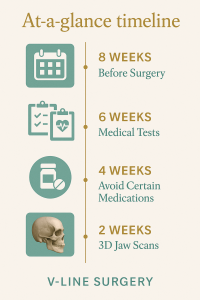
T-7 to T-1 days: anti-inflammatory diet, final medication holds, skin prep, airway hygiene; the daily preparing for V-line surgery: pre-op checklist becomes your routine.
Surgery day: fasting, ID verification, imaging review, surgical site marking; the execution phase of preparing for V-line surgery: pre-op checklist discipline.
🗒 Pre-Op Preparation Steps for V-Line Surgery
✅ Confirm candidacy and goals (T-8 to T-6 weeks)
Align with your surgeon on overall health and desired aesthetic outcomes.
Medical history: Share details about heart, lung, endocrine, or bleeding issues.
Imaging: Complete CBCT or CT scans for jaw and chin planning.
Goal setting: Define the look you want—refined, more masculine, or softer.
✅ Complete labs, dental, and airway checks (T-8 to T-6 weeks)
Baseline labs: CBC, chemistry panel, coagulation profile.
Dental clearance: Address infections and ensure bite stability.
Airway assessment: Report snoring, sleep apnea, or past intubation issues.
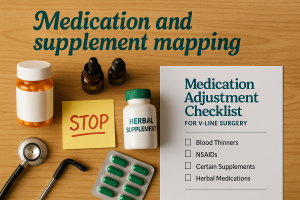
✅ Review medications and supplements (T-6 to T-3 weeks)
Blood thinners & herbals: Stop or adjust under medical guidance.
Prescription meds: Continue or adjust as instructed by your doctor.
Nicotine cessation: Quit all nicotine to boost healing.
✅ Optimize nutrition, fitness, and bone health (T-6 to T-3 weeks)
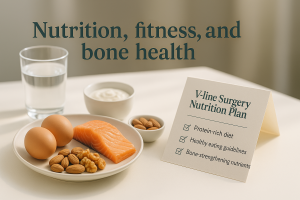
Protein intake: 1.2–1.6 g/kg/day to support bone healing.
Micronutrients: Ensure adequate calcium, vitamin D, C, and zinc.
Cardio & breathing: Daily light exercise and airway prep.
✅ Maintain skin, oral, and infection control (T-3 to T-1 weeks)
Skin care: Use gentle cleansers and avoid strong acids.
Oral hygiene: Soft brushing, alcohol-free rinses, chlorhexidine if prescribed.
Infection check: Postpone surgery if any active facial infection.

✅ Plan logistics (T-3 to T-1 weeks)
Caregiver & lodging: Arrange an escort and a recovery-friendly place.
Travel timing: Arrive 3–5 days early, stay 10–14 days after.
Documents & payments: Keep ID, consent forms, and medical files ready.
✅ Prepare recovery equipment (T-3 to T-1 weeks)
Cold compresses & jaw wrap: Essential for first days.
Soft diet supplies: Soups, yogurts, protein shakes.
Wedge pillow & humidifier: Improve comfort and airway moisture.
✅ Follow final week protocol (T-7 to T-1 days)
Medication holds: Follow exact stop dates.
Hydration & low salt: Drink 2–2.5 L water/day, reduce sodium.
Sleep & stress: Keep a calm, regular bedtime routine.
✅ 24-hour countdown

Fasting: Follow instructions for solids and liquids.
Shower & skin: Use antiseptic wash, avoid makeup or lotions.
Packing: Bring ID, meds, charger, and essentials.
✅ Morning of surgery
Arrival: Be at the clinic 60–90 minutes early.
Verification: Review consent, surgical plan, and markings.
Communication: Confirm pick-up time and medications with your caregiver.
Risk reduction through planning
Every V-line carries risks—bleeding, infection, asymmetry, temporary numbness. A robust preparing for V-line surgery: pre-op checklist doesn’t pretend risk disappears; it ensures each risk has a mitigation plan: precise medication holds, sterile skin and oral prep, airway strategy, and realistic goals. When planning is visible and repeatable, outcomes trend more predictable.
What professionals look for
Clinicians use the same preparing for V-line surgery: pre-op checklist to standardize care:
Documentation completeness (labs, imaging, clearances).
Consistent pre-op photos and occlusion records.
Confirmed caregiver and local contact information.
Explicit anesthesia notes and contingency plans.
Shared checklists mean fewer phone calls, fewer mismatches, and higher patient confidence.
🗒 Printable Pre-Op Checklist
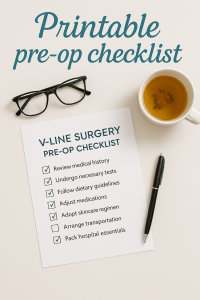
Copy this into your phone notes or print it—this is the practical, field-ready pre-op checklist you can tick off step-by-step:
✅ Medical fitness confirmed — disclose all health conditions and align goals with your surgeon.
✅ Imaging uploaded and backed up — CBCT or CT scans stored safely for planning.
✅ Baseline labs and dental clearance — complete all required medical and dental checks.
✅ Medication/supplement adjustments — approved plan in place, nicotine fully stopped.
✅ Nutrition and hydration goals met — protein and micronutrients optimized before surgery.
✅ Skin and oral hygiene — follow pre-op cleaning and care routines.
✅ Logistics finalized — caregiver, lodging, travel dates, and payments confirmed.
✅ Recovery kit ready — cold compresses, jaw wrap, and soft-diet supplies prepared.
✅ Final 7-day prep done — low-salt diet, good sleep, and stress management in place.
✅ Surgery day essentials packed — ID, consent forms, medications, and personal items ready.
FAQs about preparation
How far in advance should I start?
Most patients benefit from an eight-week runway; a staged preparing for V-line surgery: pre-op checklist helps you layer habits rather than cramming.
Can I keep taking supplements?
Only if cleared by your team. Many “natural” products increase bleeding; your preparing for V-line surgery: pre-op checklist should list exact stop dates.
What if I get a cold or acne flare?
Notify the clinic. A transparent preparing for V-line surgery: pre-op checklist includes a “pause if infected” rule to protect healing.
Will international travel change my plan?
Yes—arrive earlier, plan a longer local stay, and schedule virtual check-ins; put these specifics in a travel-ready preparing for V-line surgery: pre-op checklist.
Why plan your surgery with Dr. Mani Arash Rad

Patients choose our clinic because we make preparation visible, personal, and calm. We give every patient a digital and printable preparing for V-line surgery: pre-op checklist, tailored to their health, travel needs, and aesthetic goals. With advanced 3D planning, meticulous infection control, and multilingual coordination, your preparation feels like clockwork.
Clinic Location: Saadat Abad, Sina Medical Center, Tehran
WhatsApp Consultation: +98 919 789 0709
Website: www.drmaniarash.com
Do’s and don’ts that patients often overlook
Do photograph your face in consistent lighting before surgery; baseline images help track swelling and symmetry honestly.
Do test your blender, soft-diet recipes, and ice packs a week before—nothing is worse than realizing your gear doesn’t work on day one.
Do protect your sleep: blackout curtains, a white-noise app, and a wedge pillow make night one far more tolerable.
Don’t improvise new skincare, toothpaste, or supplements in the final week; unfamiliar products can cause rashes or bleeding risk.
Don’t hide health details from your care team; the anesthesiologist needs the full truth about smoking, vaping, or recreational substances.
Don’t crowd your calendar after surgery; recovery favors quiet routines, short walks, and hydration—not back-to-back meetings.
These small behaviors sound simple, yet they dramatically reduce avoidable stress and make the early healing window feel orderly and safe.
Final word
Whether you’re a local patient or flying in, the fastest path to a smooth experience is disciplined preparation. Use this article as your living preparing for V-line surgery: pre-op checklist, review it with your surgeon, and keep it on your phone. The more systematically you prepare, the more beautifully you recover—and the more confidently you step into your new lower-face identity.