Chin wing osteotomy has emerged as one of the most structurally transformative procedures in contemporary mandibular surgery because it targets the mandibular border’s continuity rather than isolating the chin segment alone. Unlike traditional genioplasty, which modifies only the anterior symphysis, chin wing osteotomy repositions the entire lower mandibular contour in a continuous arc from gonion to pogonion. This expanded anatomical influence allows surgeons to reshape the lower face by rebalancing mandibular width, contour projection, and structural harmony while preserving occlusal relationships. The procedure functions not as a cosmetic augmentation but as a comprehensive reengineering of skeletal architecture with long-term biomechanical consequences.
From a physiological standpoint, chin wing osteotomy modifies the load distribution along the mandibular corpus, improves muscular vector orientation, and reshapes the cervicomental transition by redefining the basal bone platform. Its integration with soft-tissue dynamics produces a natural-appearing enhancement of jawline strength, especially in patients with under-defined mandibular borders, asymmetry, or age-related skeletal resorption. Because the technique repositions native bone without introducing prosthetic materials, its long-term stability relies on osteogenesis and the restoration of functional bone continuity, making the results inherently enduring.
Functionally, chin wing osteotomy influences airway mechanics by subtly advancing the genioglossus anchor, modulates lower-facial posture, and reduces compensatory mentalis strain. These changes contribute to improved balance between tongue posture, mandibular support, and perioral tension. The increasing popularity of chin wing osteotomy reflects a paradigm shift: from surface-level contouring to deep skeletal recalibration that redefines facial strength, proportion, and long-term stability.
What you read in this article
💬 What Is Chin Wing Osteotomy?
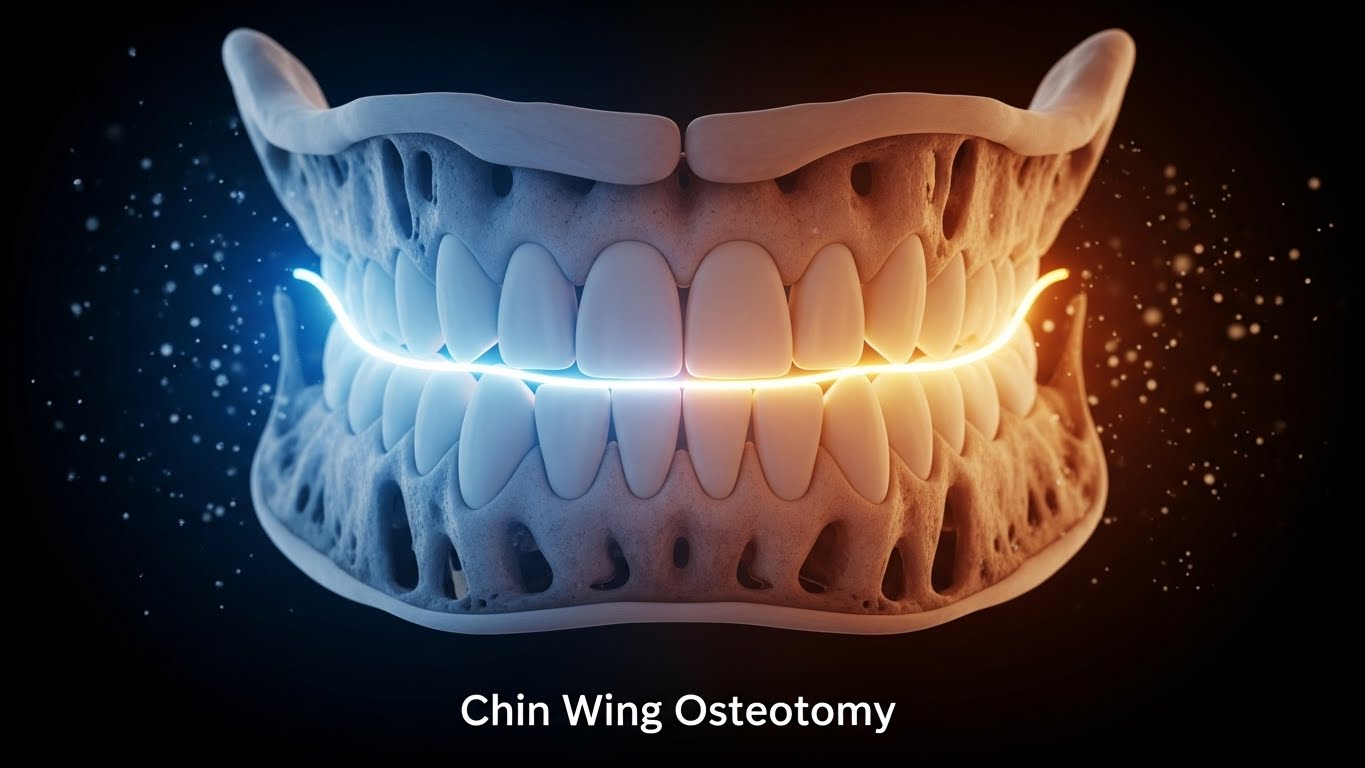
Chin wing osteotomy is a structural mandibular contour surgery that repositions the jawline from the angle of the mandible to the chin tip in a single continuous movement. By mobilizing the inferior border, it allows three-dimensional reshaping of the lower face while leaving dental occlusion intact. This characteristic distinguishes chin wing osteotomy from procedures that solely change projection without modifying basal bone architecture.


Anatomy Behind Mandibular Strength: Why Lower-Facial Architecture Matters
The structural strength of the lower face is determined by the continuity of the mandibular border, the shape of the ramus, the curvature of the corpus, the pogonion contour, and their relationships with suprahyoid and infrahyoid musculature. When the mandibular border is recessed or discontinuous, the face loses angular definition, reducing perceived skeletal power. Chin wing osteotomy restores this continuity, allowing the jawline to form a unified arc that supports soft-tissue drape more efficiently. The physiological outcome is a more resistant platform against lower-facial laxity and age-related descent.
⚙️ How Does Chin Wing Osteotomy Reposition the Mandible in Three Dimensions?
The surgical pathway follows the inferior mandibular margin from the angle to the midline, creating a mobilized segment that can be advanced, lowered, rotated, or laterally reshaped. This enables surgeons to enhance vertical height, lateral expansion, or anterior projection simultaneously. Because the procedure repositions the entire basal bone, chin wing osteotomy alters biomechanical vectors along the mandible, distributing functional forces more evenly and improving the stability of masticatory muscle interactions.
Importantly, chin wing osteotomy preserves the alveolar process and dental occlusion, making it appropriate for patients who require contour correction rather than orthognathic realignment. This separation of cosmetic contouring from dental mechanics is a central advantage of the technique.
💥 Does Chin Wing Osteotomy Create a Stronger Facial Profile?
From a biomechanical standpoint, yes. By reinforcing the mandibular border as a single structural unit, chin wing osteotomy enhances resistance to soft-tissue displacement and improves the cervicomental angle. The repositioned bone provides a more anterior and lateral scaffold, producing a sharper jawline, stronger profile, and improved facial width-to-height ratio. This skeletal recalibration continues to interact with surrounding muscles, ligaments, and submental fat compartments over time, yielding natural, age-resistant definition.
😮 Why Do Surgeons Prefer Chin Wing Osteotomy Over Conventional Genioplasty?
Whereas genioplasty focuses exclusively on the chin segment, chin wing osteotomy modifies the mandibular border in its entirety. This means that the aesthetic effect is not restricted to the midline; instead, it reshapes the entire jawline, harmonizes width, corrects asymmetry, and reinforces the mandibular angle—all without interfering with occlusion. Surgeons choose a chin wing osteotomy when the patient’s goal is structural redefinition rather than simple anterior projection.
Additionally, genioplasty cannot adequately correct lower-border deficiencies, ramus divergence, or lateral facial width, while chin wing osteotomy directly addresses these anatomical variables. Its skeletal integration produces a more authentic interaction between bone and soft tissue.
🌬️ Airway, Posture & Muscle Function: The Hidden Physiological Advantages
Chin wing osteotomy indirectly advances the genioglossus attachment, thereby widening the retrolingual airway and reducing posterior tongue collapse. Patients with mild functional airway narrowing may benefit from this structural adjustment. Furthermore, repositioning the mandibular border enhances lower facial posture, reduces mentalis overactivity, and decreases compensatory strain on the perioral musculature. This balance improves lip competence and narrows the gap between aesthetic correction and functional enhancement.


📌 Who Is the Ideal Candidate for Chin Wing Osteotomy?
The ideal candidate is an individual with insufficient mandibular border definition, mild asymmetry, ramus narrowing, flat lateral contour, or age-related skeletal resorption. Patients who seek contour enhancement beyond the chin itself benefit most, as chin wing osteotomy affects the entire mandibular shape. Individuals with strong soft-tissue volume but weak skeletal support also respond well, as bone repositioning provides a more stable base for the lower facial drape.
Risks, Limitations & Long-Term Stability: What the Evidence Shows
Peer-reviewed studies demonstrate that chin wing osteotomy provides highly stable long-term outcomes through osteogenic healing, functional load distribution, and occlusal preservation. Risks include transient sensory changes, swelling, or contour irregularity during early healing, though these are typically self-limited. Because the technique repositions native bone, the risk of long-term incompatibility is lower than in prosthetic augmentation. External reference: Mayo Clinic’s guidelines on facial skeletal surgery emphasize the durability of bone-based reconstruction over soft-tissue or prosthetic methods (source: https://www.mayoclinic.org).
❓ FAQs (Schema-Friendly)
Does a chin wing osteotomy change my occlusion?
No, the procedure modifies the mandibular border but leaves the alveolar process and dental occlusion untouched.
Is the chin wing osteotomy permanent?
Yes. Stability relies on natural bone healing, ensuring structurally enduring results.
Does the surgery improve jawline symmetry?
It can correct asymmetry along the entire border, not just at the midline.
Will a chin-wing osteotomy improve airway space?
It may provide mild retrolingual improvement by advancing muscular attachments.
How long is the recovery?
Most patients resume normal activity after 10–14 days, with bone maturation continuing for months.
⭐ Why Trust Dr. Mani Arash Rad?
Dr. Mani Arash Rad is a specialist in V-line contouring, chin wing osteotomy, and lower facial skeletal enhancement, known for producing structurally natural, biomechanically sound results. His approach integrates advanced anatomical analysis with individualized surgical planning, ensuring each patient receives a treatment pathway that supports long-term harmony between bone, muscle, and soft tissue. His outcomes emphasize precision, stability, and a naturally powerful jawline aesthetic.
Address: Tehran, Saadat Abad, Sarv Gharbi, Bakhshayesh St., Fifteenth Street West, Sinam Medical Building, Third Floor, Unit 11
Phone: 02122364547 — 02126760580 — 09197890709
WhatsApp: 09197890709
Website: www.drmaniarash.com
Clinic Hours: Saturday, Monday, Wednesday — 3 PM to 8 PM