What you read in this article
Myths vs Facts About V-line Jaw Surgery
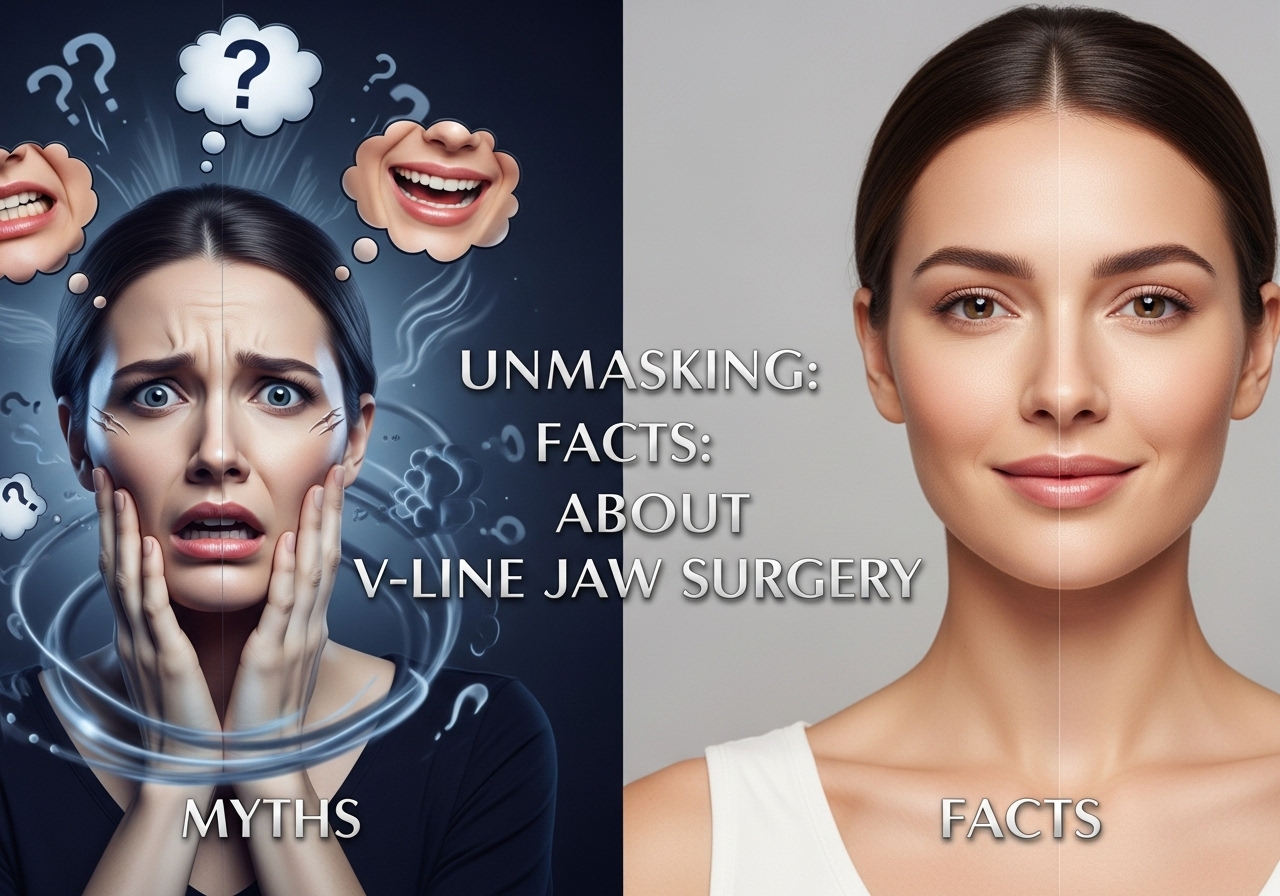
When it comes to jawline contouring, few procedures are surrounded by as much buzz and curiosity as V-line jaw surgery. Scroll through social media or read online forums, and you’ll find countless opinions, claims, and “insider tips.” Some sound convincing, while others are misleading or flat-out wrong. That’s why sorting out myths vs facts about V-line jaw surgery is so important for anyone considering this transformative operation.
This article explores the most common misconceptions, contrasts them with scientific realities, and shows why knowing the difference can make or break your expectations. By focusing only on myths vs facts about V-line jaw surgery, we can cut through the noise and reveal what patients, both men and women, actually need to understand before making a decision.

Why myths spread so easily
Medical procedures often attract myths for three reasons: fear, lack of accurate information, and the speed of social media. People share dramatic stories faster than nuanced truths. Photos get reposted without context. And because V-line jaw surgery permanently reshapes bone, it sparks both fascination and anxiety.
That’s why it’s critical to compare myths vs facts about V-line jaw surgery side by side. When you separate fear-based exaggerations from real clinical evidence, the procedure becomes less mysterious and more approachable.
Myth 1: V-line jaw surgery is only for women
✨ Fact: This is one of the biggest misconceptions. Many believe that V-line surgery exists solely to create a “cute” or “feminine” jawline. In reality, the surgery is highly adaptable. For men, it can create a strong, sharp, and masculine contour by refining asymmetry and balancing proportions. For women, it often softens the jaw for a more delicate look. The truth is that myths vs facts about V-line jaw surgery highlight its versatility across genders.
Myth 2: The results always look unnatural
✨ Fact: This myth comes from outdated techniques and overdone examples. Modern technology—like 3D planning, CT-based simulations, and patient-specific surgical guides—makes it possible to design jawlines that blend seamlessly with natural facial features. When performed by a skilled surgeon, results look like a refined version of the patient’s own face, not a template copied onto everyone. In understanding myths vs facts about V-line jaw surgery, one must recognize that “unnatural” results are the exception, not the rule.
Myth 3: V-line jaw surgery is extremely painful and dangerous
✨ Fact: Any surgical procedure carries some risk, but this myth exaggerates reality. With modern anesthesia, patients do not feel pain during surgery. Post-operative discomfort is usually manageable with prescribed medication. Swelling, tightness, and numbness are expected but temporary. As for safety, major complications are rare when surgery is performed by qualified specialists in accredited medical centers. The danger lies in believing myths instead of examining the true facts about V-line jaw surgery.
Myth 4: It’s only about beauty, not function
✨ Fact: While aesthetics are often the main motivation, functional benefits are a hidden truth. Many patients with jaw misalignment, chin deviation, or asymmetrical bites gain improved chewing efficiency and jaw comfort after surgery. Correcting bone imbalances can even reduce strain on temporomandibular joints (TMJ). Exploring myths vs facts about V-line jaw surgery shows that it can be both cosmetic and functional.

Myth 5: Recovery takes years
✨ Fact: Healing does take time, but not years. Most patients return to daily routines within 3–4 weeks. Swelling peaks in the first week and steadily decreases over months. The jawline continues to refine as tissues settle, with final results visible around 6–12 months. Labeling recovery as “years” is a myth rooted in misunderstanding. The fact is that most patients feel socially ready far sooner.
Myth 6: Everyone ends up with the same “V-shape”
✨ Fact: The idea that all patients walk away with identical results is false. Each surgical plan is customized to bone structure, gender, ethnicity, and personal goals. A man in his 30s seeking sharper definition will not receive the same adjustments as a woman in her 20s wanting a softer taper. In comparing myths vs facts about V-line jaw surgery, this point emphasizes personalization over uniformity.
Myth 7: Non-surgical options achieve the same results
✨ Fact: Fillers, Botox, and thread lifts can temporarily influence the jawline’s appearance. But none can permanently reduce bone angles or reposition the chin. These methods are like painting the surface of a wall, while surgery is like rebuilding the wall itself. That’s why the “non-surgical alternative” is a myth—only surgery can restructure bone for lasting balance.

Myth 8: V-line jaw surgery erases individuality
✨ Fact: Another misconception is that surgery makes everyone look like a “clone.” In fact, the opposite is true. Properly executed surgery enhances natural individuality by correcting imbalances without erasing unique features. When comparing myths vs facts about V-line jaw surgery, the reality is that individuality is preserved, not destroyed.
Why believing in myths can be risky
Trusting myths doesn’t just spread misinformation—it can cause harm. Patients who believe in exaggerated recovery times might avoid surgery even when it could improve their quality of life. Those who expect “instant perfection” may feel disappointed despite excellent results. Sorting myths vs facts about V-line jaw surgery is more than educational—it directly impacts patient confidence, satisfaction, and decision-making.
Frequently Asked Questions
Is V-line jaw surgery permanent?
Yes. Once the bone is reshaped, results are permanent. Soft tissues continue to age naturally, but the jawline contour remains.
Can men benefit from this surgery?
Absolutely. Men seeking stronger, more defined jawlines are increasingly undergoing the procedure.
How painful is the recovery really?
Discomfort is common but manageable with prescribed medications. Most describe it as pressure and swelling rather than sharp pain.
Can fillers replace surgery?
No. Fillers provide volume and contour adjustments but cannot reduce or reposition bone.
How long until I see results?
Swelling decreases steadily; noticeable definition appears within weeks, with final results around 6–12 months.
Why Trust Dr. Mani Arash Rad

When myths cloud judgment, facts matter most. Dr. Mani Arash Rad emphasizes transparency, education, and patient-centered planning. His approach to myths vs facts about V-line jaw surgery involves clear consultation, realistic goal-setting, and the use of advanced 3D planning for accuracy. Patients from around the world trust his blend of technical precision and natural artistry.
📍 Location: Saadat Abad, Sina Medical Center, Tehran
📱 WhatsApp: +98 919 789 0709
🌐 Website: www.drmaniarash.com