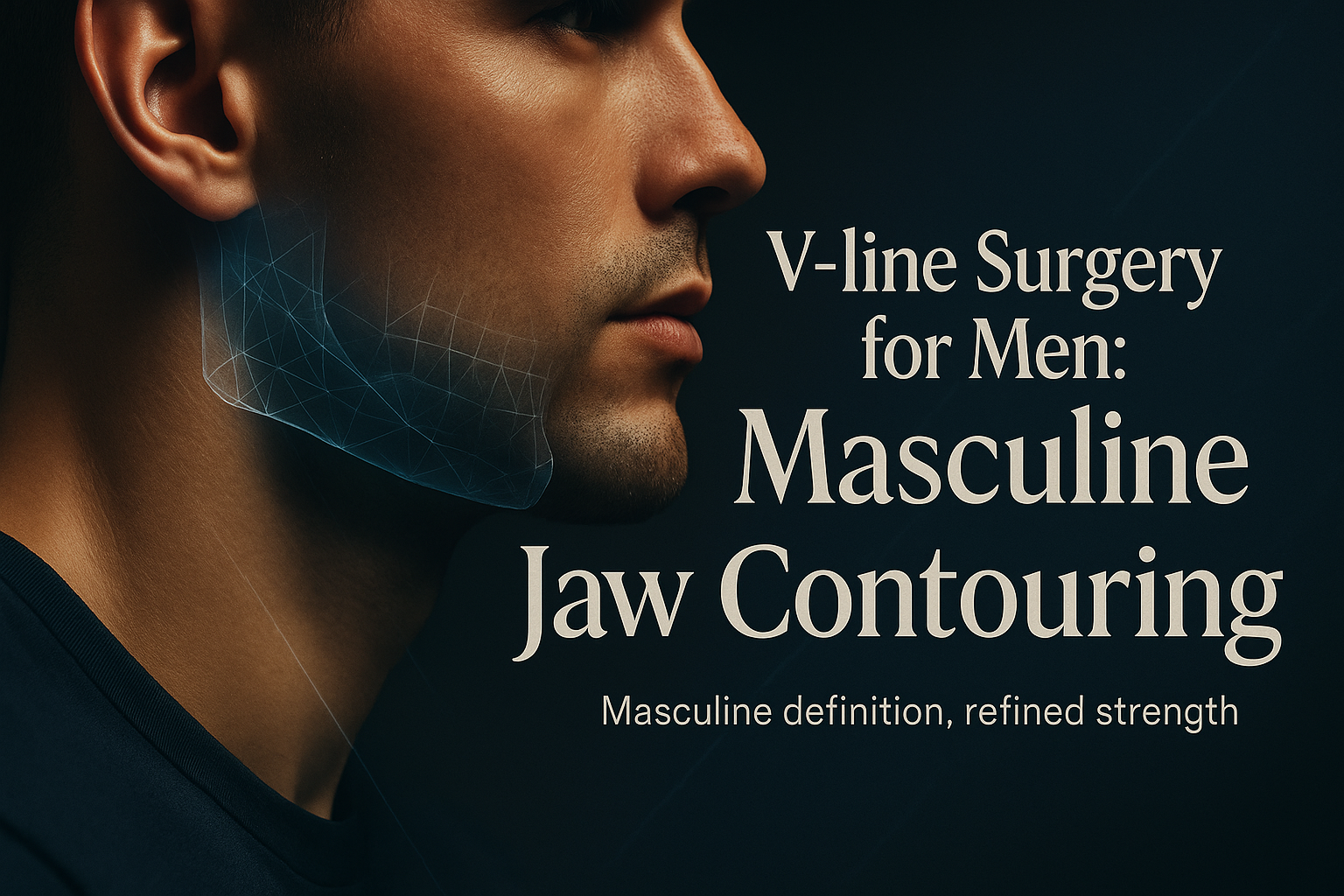
V-line surgery for men: masculine jaw contouring is not about making the face “feminine” or softening it indiscriminately—it’s about refining and defining a strong lower face while preserving essential masculine character. As more men seek facial harmony that balances angularity with proportion, understanding how V-line techniques are adapted for masculine aesthetics is critical. This article explains the anatomical principles, surgical modifications, candidate selection, aesthetic goals, and key considerations that distinguish V-line surgery for men: masculine jaw contouring from conventional approaches, helping prospective patients make informed decisions.
What you read in this article
Understanding masculine facial anatomy in the context of V-line surgery for men
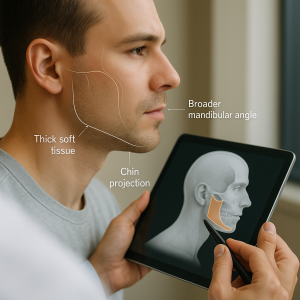
The foundation of successful V-line surgery for men: masculine jaw contouring lies in a nuanced understanding of male facial anatomy. Men typically have a broader, more prominent mandibular angle, a square or slightly angular lower face, and thicker soft tissue coverage. These features convey strength and character. Unlike the classical “V-line” ideal often associated with a tapered, narrow jaw in women, masculine jaw contouring seeks a refined but robust jawline: one that is sharp in definition without appearing gracile or overly narrowed.
Surgeons performing V-line surgery for men: masculine jaw contouring evaluate jaw width, chin projection, jaw angle prominence, and the relationship between the lower face and overall facial balance. The aim is to enhance the “V” in a way that maintains breadth where appropriate, provides a defined transition from jaw to chin, and avoids over-reduction that would diminish perceived masculinity.
Goals of V-line surgery for men: preserving strength while refining shape
When planning V-line surgery for men: masculine jaw contouring, the goals differ from those of feminizing contouring. Key objectives include:
- Definition without feminization: Creating a cleaner lower facial silhouette while retaining a strong, square or subtly tapered jaw that reads as masculine.
- Harmonizing proportions: Adjusting the chin and jaw angles so the face appears balanced—neither overly bulky nor unnaturally narrow.
- Maintaining facial character: Avoiding the “softening” effect that can erase individuality; instead, refining existing structure.
- Enhancing angularity selectively: Sharpening specific borderline areas (like the jawline border or chin projection) while preserving overall mandibular presence.
In V-line surgery for men: masculine jaw contouring, the “V” is not a delicate point but a controlled narrowing that emphasizes the lower third without weakening the appearance of strength.
Surgical technique adaptations for masculine jaw contouring
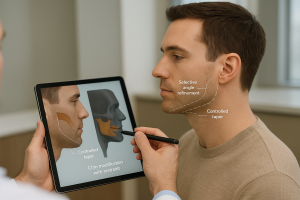
Standard V-line surgery often involves angle reduction and chin reshaping to achieve a tapered point. For V-line surgery for men: masculine jaw contouring, techniques are modified:
Selective mandibular angle refinement: Instead of aggressive narrowing, the surgeon may shave or contour the outer border of the jaw to soften excessive squareness while keeping underlying width that denotes masculinity.
Chin modification with restraint: Chin reshaping (genioplasty) is tailored to avoid creating a tapered, pointed chin; the shape tends toward a broader, more projected form depending on the patient’s face. Sliding genioplasty or minor advancement can improve definition without feminizing the profile.
Maintaining strong jaw angles: Rather than removing all angular bulk, the surgeon preserves or subtly sharpens the angle to keep the impression of structure.
Avoiding over-tapering: The design phase explicitly evaluates how much taper is acceptable—V-line surgery for men: masculine jaw contouring balances refinement with the need to keep the lower face grounded.
Internal incisions and soft tissue handling: As with other V-line procedures, incisions are usually hidden intraorally, but soft tissue repositioning is calibrated so the jaw retains its masculine fullness while the overlying contour becomes crisper.
These nuances ensure V-line surgery for men: masculine jaw contouring produces a jawline that reads as “enhanced” rather than “altered.”
Candidate selection: who benefits most
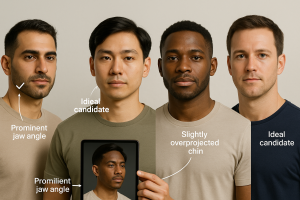
Ideal candidates for V-line surgery for men: masculine jaw contouring are men with:
Prominent or wide jaw angles seeking definition without loss of strength.
A disproportionate chin that detracts from lower-face harmony (either retruded or slightly overprojected).
A desire to refine the jawline while preserving a masculine appearance—not to feminize the lower face.
Facial structure where a subtle reduction or sculpting can improve jaw-to-chin transition and overall balance.
Patients with diffuse fullness from soft tissue rather than bone may require adjunct non-surgical refinement first; the core of V-line surgery for men: masculine jaw contouring remains structural, so a clear assessment distinguishes when bone modification is appropriate versus when muscle or fat modulation could help.
Preoperative planning specific to masculine goals
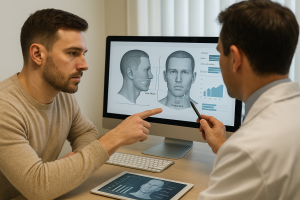
Comprehensive preoperative planning is essential in V-line surgery for men: masculine jaw contouring to avoid unintended feminization or disproportion. Planning includes:
- 3D imaging and morphometric analysis to measure jaw width, chin height/projection, and facial proportion lines.
- Customized design sessions where the patient’s concept of masculinity is discussed—some men prefer a very angular jaw; others want a softened but still strong look.
- Simulation of outcomes using digital mock-ups, ensuring the proposed “V” suits the patient’s overall identity.
- Discussion of trade-offs, such as how much angle reduction versus chin projection is ideal to achieve a defined but masculine contour.
- Through this lens, V-line surgery for men: masculine jaw contouring becomes a collaborative sculpting process rather than formulaic reduction.
Ethnic and cultural considerations in masculine contouring

Masculine ideals vary by ethnicity and cultural background, and V-line surgery for men: masculine jaw contouring must respect those differences. Some cultures value a wider, square jaw as a sign of authority, while others prefer a slightly tapered but strong lower face. The surgeon integrates these preferences with anatomical feasibility. Personalization ensures the outcome looks natural in the context of the patient’s heritage and gender expression, avoiding a narrow “one-size-fits-all” standard.
Combining V-line surgery for men with complementary procedures
- Often, V-line surgery for men: masculine jaw contouring is more effective when combined selectively with other procedures to support overall balance:
- Masseter reduction (e.g., neuromodulators) if muscle bulk contributes to lower-face width, done carefully to avoid softening strength.
- Neck liposuction or submental tightening to enhance the jawline’s visual separation without removing its structural presence.
- Rhinoplasty or midface adjustments when improving lower-face contours reveals proportional discrepancies elsewhere.
- Combination plans are crafted so that the masculinity of the lower face remains intact while adjacent features are harmonized.
Psychological and identity alignment
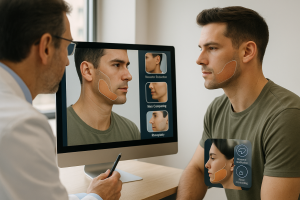
Men seeking V-line surgery for men: masculine jaw contouring often do so to feel more confident without losing their sense of self. Clear communication about what “masculine refinement” means to each individual avoids misalignment. The surgeon must explore whether the patient’s goal is increased definition, correction of perceived imbalance, or subtle reshaping without altering gendered appearance. Establishing this alignment is a unique component of successful masculine V-line contouring.
Postoperative expectations (focused on shape, not timeline)
After V-line surgery for men: masculine jaw contouring, patients will notice a tighter, more defined jaw with preserved strength—initial swelling may soften sharpness temporarily, but the refined masculine contour emerges as healing progresses. Men are often advised on scar care (though incisions are typically hidden), soft tissue support, and gradual reintroduction of facial expressions to ensure the new shape integrates seamlessly with natural movement. Follow-up includes assessment of chin projection and jaw angles to confirm that the masculine design intent has been maintained.
Common pitfalls in masculine V-line planning and how they’re avoided
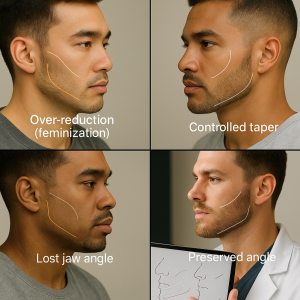
In V-line surgery for men: masculine jaw contouring, errors commonly arise when surgeons apply feminizing templates or over-reduce, making the jaw appear narrow, weak, or incongruent with male facial proportions.
Avoidance strategies include:
- Using masculine reference points during planning rather than default “V-line” female ideals.
- Validating proposed changes with the patient’s self-perception—digital previews help align expectations.
- Conservatively tapering rather than aggressively shaving bone unless clearly indicated.
- Preserving key structural shadows and angles that signal masculinity (e.g., defined jaw angle, appropriate chin width).
- Intentional restraint differentiates thoughtful V-line surgery for men: masculine jaw contouring from generic contouring.
Selecting the right provider for masculine V-line contouring
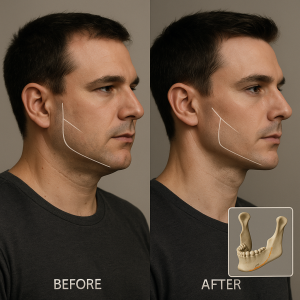
While the focus here is on surgical design, choosing a surgeon who understands male aesthetics is vital when pursuing V-line surgery for men: masculine jaw contouring. The right provider demonstrates experience with male patients, shows diverse masculine before-and-after results, discusses gender-specific design goals, and avoids pushing a softened or feminized outcome unless that is the explicit request.
Frequently Asked Questions (FAQs)
Will V-line surgery for men make my jaw look less masculine?
No—when performed with masculine contouring principles, the procedure refines definition while retaining strength and presence.
How is male V-line contouring different from the typical “V-line” look?
Masculine V-line contouring avoids overly narrow or pointed shapes; instead, it balances angularity with width to preserve a strong lower face.
Can I combine this with other procedures without weakening masculinity?
Yes. Adjunct procedures like neck refinement or minor masseter modulation can enhance the result if carefully coordinated.
Do men need different recovery considerations?
The biological healing is similar, but aesthetic monitoring focuses on ensuring the jaw remains robust and doesn’t appear softened as swelling resolves.
Is ethnic background considered in the design?
Absolutely. Cultural norms and inherent facial structure guide how the “V” is shaped to suit masculine identity authentically.
Why trust Dr. Mani Arash Rad for V-line surgery for men: masculine jaw contouring?
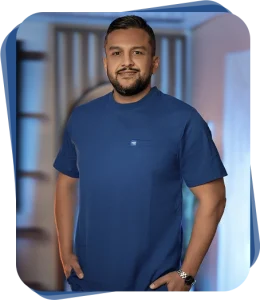
Dr. Mani Arash Rad has experience tailoring V-line surgery for men: masculine jaw contouring to preserve male strength while providing clarity and definition. His practice includes:
Personalized 3D planning focused on masculine proportions
Clear differentiation between feminizing templates and male-specific designs
Case examples of male patients with varied ethnic backgrounds
Direct involvement in surgical execution to ensure integrity of contour
📍 Clinic Location: Saadat Abad, Sina Medical Center, Tehran
📱 WhatsApp Consultation: +98 9197890709
🌐 Website: www.drmaniarash.com
V-line surgery for men: masculine jaw contouring is a distinct discipline within facial contouring. It requires deliberate planning to refine the jawline while honoring masculinity, avoiding over-softening, and balancing strength with proportion. Men who pursue this with the right surgical partner—one who understands the subtleties of gendered facial aesthetics—achieve results that feel both natural and empowering.