What you read in this article
V-line surgery vs non-surgical jaw contouring: Anatomy, Indications, and Smart Combination Strategies
V-line surgery vs non-surgical jaw contouring is a foundational comparison for anyone seeking lower-face refinement, especially international patients coming to Tehran for expert guidance. Rather than repeating common talking points about cost or recovery schedules, this article focuses on the biological basis, candidacy differentiation, procedural mechanics, psychological readiness, strategic sequencing, myth-busting, and how to blend both approaches when appropriate. The goal is to help readers clearly understand when structural change is needed, when surface modulation suffices, and how to navigate between the two with a plan rooted in anatomy and individual goals.
Core conceptual difference: V-line surgery vs non-surgical jaw contouring
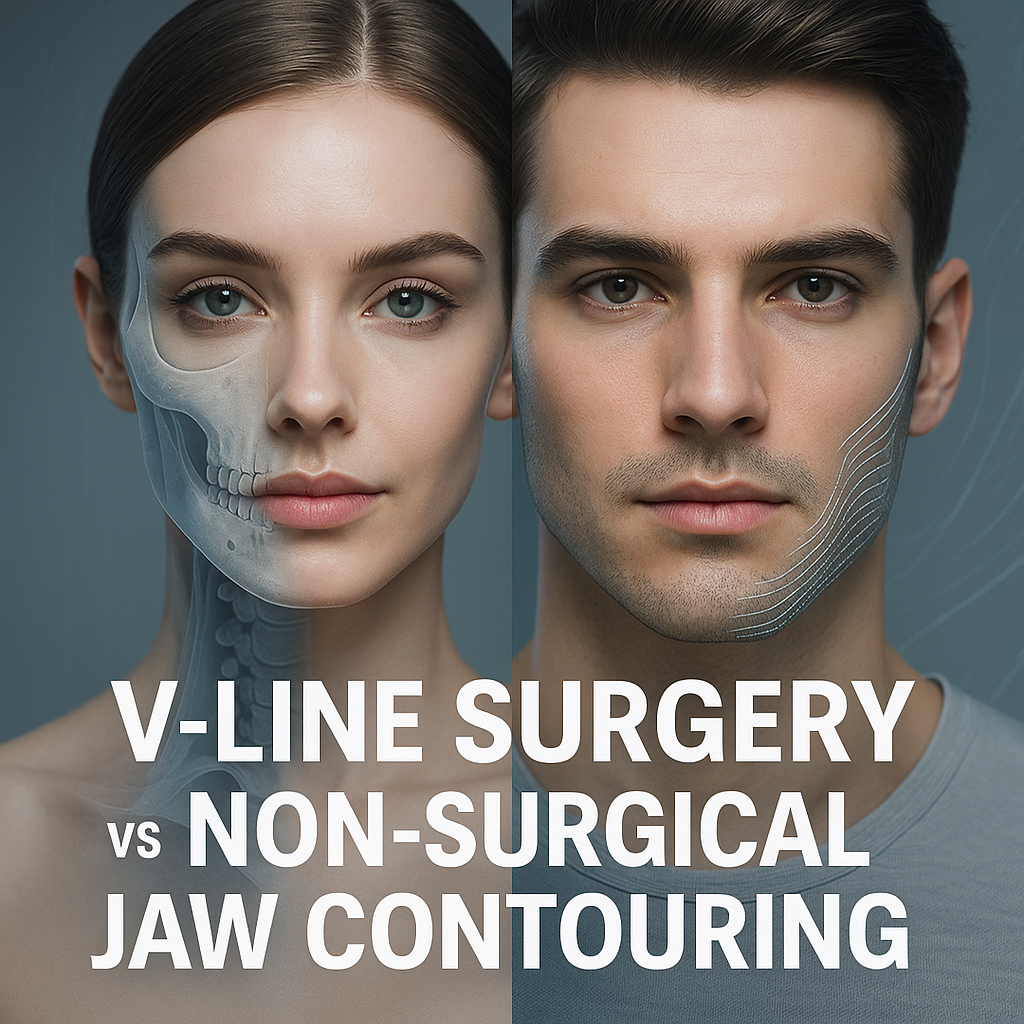
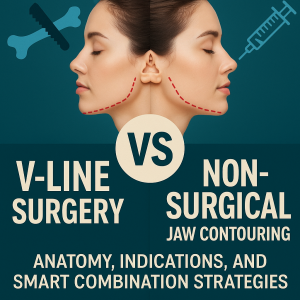
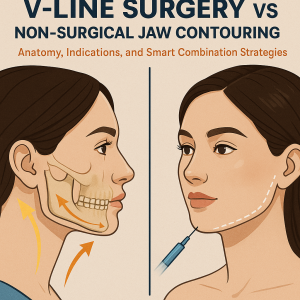
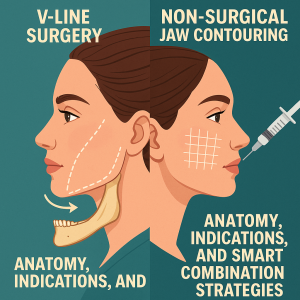
The phrase V-line surgery vs non-surgical jaw contouring encapsulates two fundamentally different philosophies of facial shaping. V-line surgery operates at the skeletal level, modifying bone structure—reducing mandibular angles, reshaping the chin, or combining osteotomies—to craft a permanent tapered lower face. Non-surgical jaw contouring, by contrast, uses soft-tissue techniques such as neuromodulators (e.g., masseter Botox), filler placement, thread lifts, or energy-based skin tightening to simulate slimmer contours without touching bone. Understanding this distinction is the first step in selecting the approach that fits a patient’s anatomy and expectations.
Anatomical indications and patient profiling
A thoughtful exploration of V-line surgery vs non-surgical jaw contouring begins with facial analysis. Candidates with a prominent bony jaw angle, true mandibular width, or disproportionate chin projection generally require the definitive reshaping that V-line surgery provides. Those with fullness due to muscle hypertrophy (e.g., enlarged masseter), mild soft-tissue sagging, or early facial aging may benefit more from non-surgical jaw contouring. Accurate profiling—often via 3D imaging and physical examination—allows surgeons to categorize whether the primary driver is bone, muscle, skin laxity, or a combination, thereby directing the choice along the V-line surgery vs non-surgical jaw contouring spectrum appropriately.
Mechanisms: structural vs surface modulation
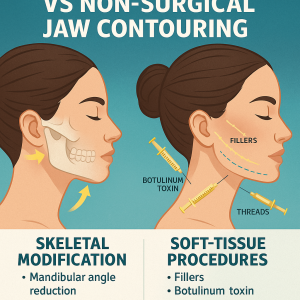
When considering V-line surgery vs non-surgical jaw contouring, the mechanisms of change define limits and possibilities. V-line surgery restructures osseous anatomy: mandibular angle reduction (removing or shaving bone), genioplasty (modifying the chin), and sometimes adjunct bone advancement or retraction to harmonize proportion. These are permanent geometric alterations yielding predictable contour shifts.
Non-surgical jaw contouring achieves a more subtle transformation. Botox injected into the masseter reduces muscle bulk over weeks, creating a slimming effect without modifying bone. Dermal fillers can soften asymmetries or enhance chin projection temporarily. Thread lifting offers mild elevation and tensioning of soft tissues, and radiofrequency or ultrasound devices stimulate skin tightening. Each of these modifies appearance via soft-tissue volume redistribution or muscle activity—not bone—and thus serves a different role within the V-line surgery vs non-surgical jaw contouring decision tree.
Psychological readiness and aesthetic goals
A critical but often overlooked comparison in V-line surgery vs non-surgical jaw contouring is patient mindset. Structural change via surgery is permanent and requires commitment; non-surgical interventions offer flexibility but can create a cycle of repeat treatments. Teasing out whether a patient seeks a long-term identity shift or temporary enhancement helps inform whether to lean toward the “surgery” side or “non-surgical” side in the V-line surgery vs non-surgical jaw contouring equation. Psychological preparedness, tolerance for change, and cultural aesthetic expectations (especially for international patients assessing their own “ideal” V-line) must be aligned prior to intervention.
Decision framework: when to choose which path
To simplify V-line surgery vs non-surgical jaw contouring decisions, the following structured framework is useful:
- Identify primary anatomical cause (bone prominence vs muscle bulk vs soft-tissue laxity).
- Clarify permanence wants (desire for one-time lasting change vs trial/flexibility).
- Evaluate risk tolerance (surgery carries different risks than minimally invasive modulation).
- Determine sequencing (whether to test soft-tissue modulation before committing to surgery).
- Assess facial harmony (some patients benefit from combining both in staged fashion).
- Factor cultural and identity alignment (how the result fits with patient’s self-image).
This framework anchors the V-line surgery vs non-surgical jaw contouring choice in objective assessment and reduces regret.
Combining both intelligently
The most nuanced application of V-line surgery vs non-surgical jaw contouring is not a binary choice but a hybrid pathway. For example, a patient may begin with non-surgical jaw contouring to experiment with a slimmer appearance; if the desired change proves beneficial, they may proceed to V-line surgery for a permanent foundation. Conversely, after structural V-line surgery, non-surgical refinement (fillers for minor asymmetry, neuromodulators for soft-tissue balancing) can enhance and maintain harmony. Expert planning in Tehran allows this integration to respect healing phases while maximizing aesthetic coherence.
Technology and precision in the comparison
Advances in digital planning tip the V-line surgery vs non-surgical jaw contouring balance toward precision. Virtual 3D simulation maps skeletal considerations for surgery and predicts soft-tissue response, helping distinguish whether changes would be sufficient with non-surgical methods or require surgical intervention. Imaging also lets patients visualize combined protocols, clarifying expectations and selecting their path with confidence.
Common misconceptions
Within V-line surgery vs non-surgical jaw contouring, myths persist. One is that non-surgical jaw contouring can “replace” bone reduction; in truth, it can only mimic or complement structural change lightly. Another is that surgery will always look artificial—when performed by skilled maxillofacial surgeons, particularly those experienced with regional facial characteristics like Dr. Mani Arash Rad, the emphasis is on proportionate, culturally consonant refinement. Some believe starting with non-surgical means they won’t need surgery; others think surgery negates all need for soft-tissue fine-tuning. The real insight from the V-line surgery vs non-surgical jaw contouring dialogue is that the best outcome often comes from thoughtful sequencing, not rigid adherence to one camp.
Cultural and ethnic considerations
The V-line surgery vs non-surgical jaw contouring debate must incorporate ethnic facial norms. For instance, reducing mandibular width in ways that conflict with regional bone structure or aesthetic ideals can backfire. Tehran’s expert surgeons tailor the balance—choosing whether to pursue structural V-line surgery vs non-surgical jaw contouring or a combination—based on preserving identity while achieving the desired taper. Patients from diverse backgrounds benefit from this contextualized assessment, ensuring that their V-line looks like a natural evolution, not a transplanted trend.
Patient education and informed consent
In any V-line surgery vs non-surgical jaw contouring consultation, transparency is essential. International patients should be educated about: anatomical drivers, expected duration of effects (permanent vs temporary), maintenance needs, and how blending modalities could work. Fully informed consent includes understanding that non-surgical contouring requires repeat sessions for sustained effect, while surgical intervention carries permanence with a different risk profile. Being fluent in the vocabulary of the V-line surgery vs non-surgical jaw contouring spectrum empowers patients to ask the right questions and set realistic goals.
Post-intervention maintenance (without repeating recovery timeline)
Even outside of recovery scheduling, the long-term perspective in V-line surgery vs non-surgical jaw contouring matters. Surgical results typically demand minimal upkeep after healing, while non-surgical changes need periodic touch-ups. However, patients who undergo V-line surgery may benefit from occasional non-surgical refinements to counter minor soft-tissue shifts over many years, blending the durability of bone work with the adaptability of surface modulation.
Why choose Dr. Mani Arash Rad to navigate V-line surgery vs non-surgical jaw contouring?
Dr. Mani Arash Rad

Dr. Mani Arash Rad is a leading oral and maxillofacial surgeon in Tehran who excels at guiding international patients through the nuanced comparison of V-line surgery vs non-surgical jaw contouring. His approach is individualized: assessing skeletal architecture, soft-tissue dynamics, and the patient’s cultural and psychological goals. His clinic offers:
• Advanced 3D diagnostic imaging to differentiate between structural and surface needs
• Clear pathing (surgery-first, non-surgical trial, or staged hybrid) based on evidence, not trend
• Multilingual coordination for patients arriving from abroad
• Strategic combination planning to optimize long-term facial harmony
• Ethical, identity-preserving aesthetic judgments tailored to each face
✨ With Dr. Rad, the choice between V-line surgery vs non-surgical jaw contouring is not a gamble—it’s a calibrated plan that fits your anatomy and self-image.
📍 Clinic Location: Saadat Abad, Sina Medical Center, Tehran
📱 WhatsApp Consultation: +98 9197890709
🌐 Website: www.drmaniarash.com
Frequently Asked Questions (FAQs)
- What’s the fundamental difference in goals between V-line surgery vs non-surgical jaw contouring?
Surgery alters bone for permanent tapering; non-surgical methods adjust soft tissue or muscle temporarily.
- Can I try non-surgical jaw contouring first before committing to V-line surgery?
Yes. Testing with surface techniques helps set expectations and refine the decision within the V-line surgery vs non-surgical jaw contouring spectrum.
- Is combining both approaches safe or recommended?
Combining intelligently—structural base with soft-tissue refinement—is often the best expression of V-line surgery vs non-surgical jaw contouring synergy.
- How do ethnic and identity factors play into the choice?
Expert evaluation ensures that whether opting for V-line surgery vs non-surgical jaw contouring, the result strengthens identity rather than imposing foreign aesthetics.
- Which approach offers more control over incremental changes?
Non-surgical jaw contouring allows gradual tweaks; surgery provides a foundational change, after which surface adjustments can fine-tune.
The decision between V-line surgery vs non-surgical jaw contouring is deeply personal and anatomically driven. International patients coming to Tehran gain access to a clinician-led process that respects structure, identity, and long-term harmony. Whether you seek a structural transformation, flexible modulation, or a staged combination, a clear assessment and strategy—guided by experts like Dr. Mani Arash Rad—ensures your lower-face contours reflect who you are, not just what’s trending.