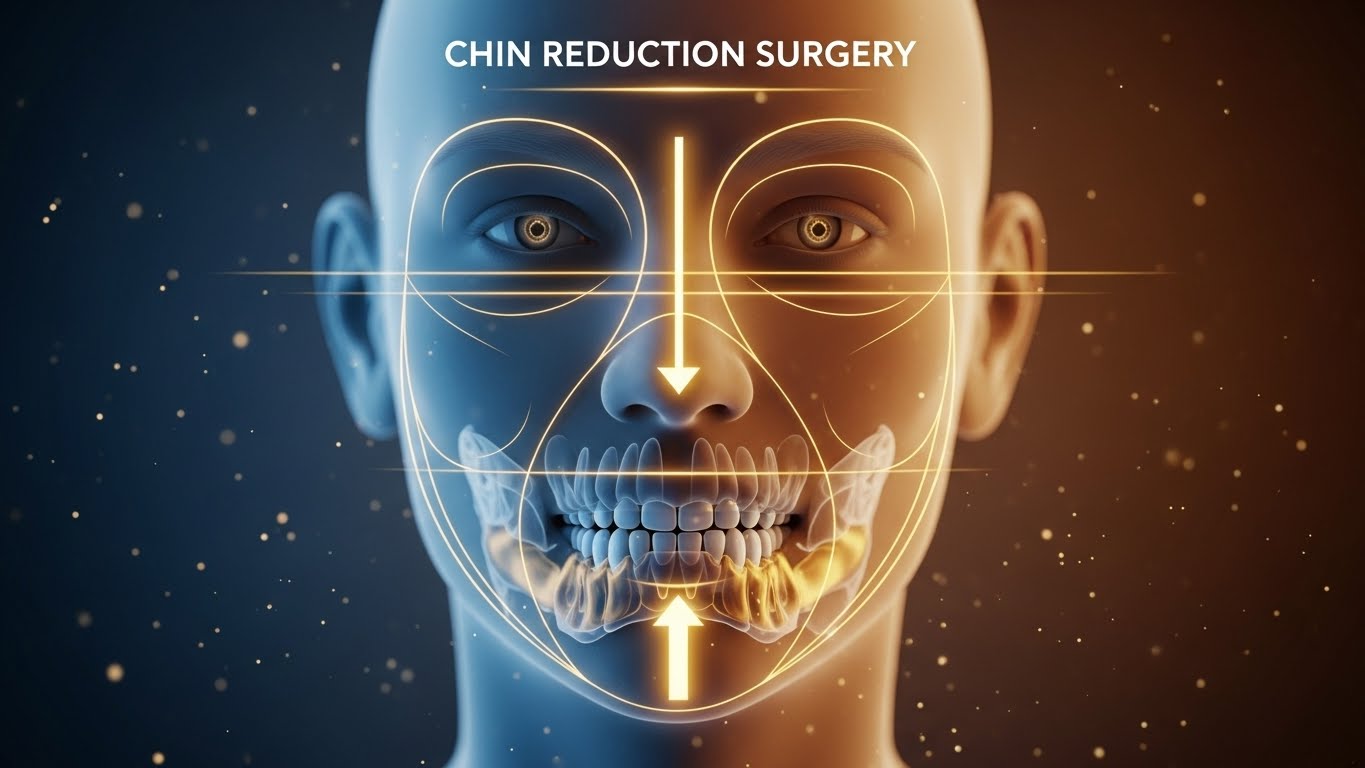
Among lower-facial procedures designed to restore proportional balance, vertical chin reduction surgery is one of the least discussed yet most structurally influential. Unlike horizontal genioplasty, which modifies the anterior projection, vertical chin reduction surgery targets the lower third of the face, correcting excessive vertical length that distorts classical aesthetic ratios. Excessive chin height alters mandibular symphysis curvature, increases facial elongation, disrupts the lower facial third, and shifts the balance between upper, mid, and lower facial segments. This procedure repositions and shortens the skeletal structure through controlled wedge osteotomy or segmental reduction, followed by reapproximation of the cortical surfaces to preserve mandibular integrity.
Biomechanically, reducing chin height alters load distribution along the anterior mandible and reduces mentalis strain by shortening the distance between the lower lip and bony support. As vertical height decreases, the soft tissue envelope adapts, improving lip competence, reducing mentalis hyperactivity, and reshaping the sublabial contour. A shortened vertical dimension alters shadow lines on the frontal and oblique views, widens the perceived jawline, and enhances the facial width-to-height ratio.
Functionally, vertical chin reduction surgery can influence the posture of the lower lip, potentially decrease compensatory contraction patterns, and harmonize the curvature of the mandibular outline. Because vertical excess is often overlooked in standard aesthetic analyses, addressing it reveals underlying imbalances that cannot be corrected solely by augmentation or projection. As interest in facial proportion science expands, vertical chin reduction surgery has become an essential technique for restoring balanced aesthetics, structural coherence, and long-term harmony across the entire lower facial third.
What you read in this article
💬 What Is Vertical Chin Reduction Surgery?
Vertical chin reduction surgery is a specialized mandibular contouring procedure that shortens the height of the chin by removing a controlled segment of bone from the symphysis. By reducing the vertical distance between the lower lip and the chin point, the entire lower third of the face becomes more proportionate, producing a balanced aesthetic in both profile and frontal views.


📐 Why Does Excessive Chin Height Disrupt Facial Harmony?
A long chin shifts the aesthetic balance of the face by extending the lower third beyond ideal proportions. Facial harmony depends on equilibrium between the upper, mid, and lower facial segments. When the lower third is elongated, the face appears narrower, more angular, and less symmetrical.
Vertical excess also changes the curvature of the mandibular symphysis, altering how light and shadow articulate along the lower contour. The submental angle becomes steeper, the labiomental fold appears deeper, and the lower lip may look strained due to extended muscular tension. Vertical chin reduction surgery corrects these distortions by restoring ideal ratios and improving skeletal-ligamentous balance.
✂️ 🛠️ How Does Vertical Chin Reduction Surgery Technically Shorten the Chin?

The procedure begins with an osteotomy across the anterior mandible. Depending on the patient’s anatomy, surgeons may use a wedge resection, removing a triangular segment of bone, or a segmental reduction technique that preserves mandibular curvature. After the bone segment is removed, the remaining bony edges are approximated and fixed with titanium plates to maintain stability.
Because vertical chin reduction surgery removes height rather than repositioning the bone downward or forward, the symphysis becomes more compact, improving lower-lip support and producing a more concise skeletal foundation. The mentalis muscle undergoes tension recalibration, adapting to the reduced vertical span and creating a smoother transition from lip to chin.
🔍 😮 Is the Improvement More Visible from the Side Profile or the Frontal View?
Vertical chin reduction surgery affects both, but in different ways.
On the profile, reducing vertical height softens the sublabial curvature, shortens the lower facial axis, and improves the labiomental angle. The chin no longer draws the lower third downward, allowing the midface and jawline to appear more connected.
On the frontal view, shortening the chin shifts attention to facial width, making the jawline seem broader and more proportionate. The chin shadow becomes less elongated, creating a rounded but well-defined lower facial contour. The mandible appears more symmetrical because excessive verticality no longer narrows the visual field of the lower face.
🌬️ 🧬 Functional Effects Beyond Aesthetics: Lip Seal, Muscle Dynamics & Airflow
Excessive chin height increases the distance between the lower lip and the mentalis origin, forcing the mentalis muscle to contract more intensely to maintain lip competence. This can lead to perioral strain, dimpling, or asymmetric contraction patterns.
Vertical chin reduction surgery shortens the muscular span, reducing hyperactivity and improving lower-lip posture. In some patients, this results in a stronger resting seal, less fatigue of perioral muscles, and decreased anterior lower-face tension. The improved skeletal-lip relationship also influences airflow direction and the downward angle of the oral vestibule, contributing to subtle but meaningful functional refinement.


👤 📌 Who Is an Ideal Candidate for Vertical Chin Reduction Surgery?
The ideal candidate is someone whose facial imbalance stems from excess chin height rather than insufficient projection or a narrow jawline. Patients with elongated chins often appear older, more tired, or disproportionate despite otherwise strong midface structure. These individuals benefit significantly from vertical chin reduction surgery because the root cause is skeletal height rather than soft tissue or projection deficits.
Patients with mentalis hyperactivity, strained lip seal, deep labiomental folds, or a vertically stretched frontal contour also respond favorably, as the surgery rebalances the lower facial third at a structural level.
⚖️ 📉 Risks, Limitations & Long-Term Stability
Vertical chin reduction surgery is generally stable because the bone heals through direct osteogenesis. However, changes in sensation, temporary mentalis weakness, or contour irregularities can occur during the adjustment phase.
Long-term data from facial skeletal surgery research (Cleveland Clinic) show that symphyseal modifications remain structurally stable when osteotomies and fixation are performed correctly. Soft-tissue adaptation continues for months, leading to increasingly natural results over time.
❓ FAQs
Does vertical chin reduction surgery change my bite?
No. The osteotomy is performed below the dental roots and does not affect occlusal function.
Is the shortening permanent?
Yes. The bone heals in its new, reduced height, making the results long-lasting.
Will I look less elongated?
Yes. Shortening the chin restores balance to all facial thirds.
Does it affect speech or the airway?
Minimal. Some patients report improved lower-lip posture and less muscle strain.
How long is the recovery?
Initial recovery 10–14 days; full remodeling continues for several months.
⭐ Why Trust Dr. Mani Arash Rad?

Dr. Mani Arash Rad is a specialist in advanced V-line contouring and lower-facial skeletal refinement, with extensive experience in procedures like vertical chin reduction surgery that require precise anatomical analysis and meticulous osteotomy execution. His approach prioritizes structural harmony, natural adaptation of soft tissues, and individualized planning to ensure every correction aligns with the patient’s unique skeletal architecture. His results emphasize balance, proportion, and long-term skeletal stability rather than surface-level contouring.
Address: Tehran, Saadat Abad, Sarv Gharbi, Bakhshayesh St., Fifteenth Street West, Sinam Medical Building, Third Floor, Unit 11
Phone: 02122364547 — 02126760580 — 09197890709
WhatsApp: 09197890709
Website: www.drmaniarash.com
Clinic Hours: Saturday, Monday, Wednesday — 3 PM to 8 PM